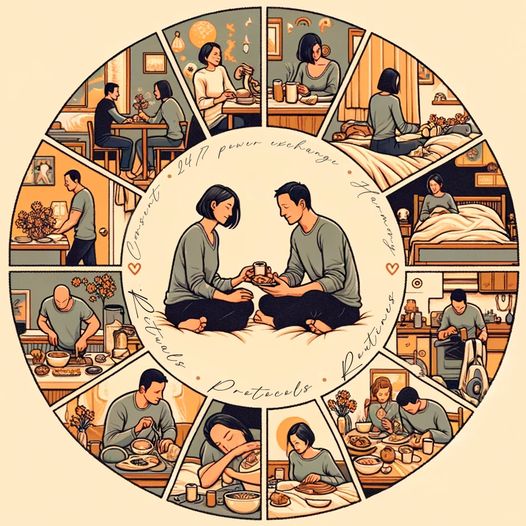

Protocols That Feel Like You, Not Like a Show

Yeah. I get it. You hear “protocols” and your brain immediately plays a movie. Perfect posture. Structured phrases. A whole aesthetic that would photograph beautifully… …and absolutely die on a Tuesday morning when the alarm is rude, the floor is cold, and breakfast is a negotiation. Most lives are not cinematic. Most mornings are not aesthetic. And most nervous systems do not need more performance. Most nervous systems need one thing: A few tiny rituals that say, “This is who I am. This is who we are,” right in the middle of the mess. So let’s talk about that. Not the showy stuff. The quiet things that actually hold you up. The exhausting morning show Picture this. You and your…

0 Comments

Rules Without Rope Burns. A Clean Model for Power and Choice

Yeah. I get it. You say “rules” and the room splits in half. One person lights up. Structure. Clarity. Order. Yes, please. Another person’s stomach drops. Control. Pressure. Old bruises waking up. And honestly… both reactions make sense. Rules can hold a dynamic together when everyone is tired. Rules can also be a polite label for: “I don’t like this, but I am scared to say no.” Same word on paper. Very different reality in the body. So let’s clean it up. Not with theory. With a simple model you can actually use on a Tuesday. The rule that feels fine until it doesn’t Picture this. You sit down together. You are excited. You write your first set of rules.…

0 Comments

Authority Without Micromanagement. Become Guidance, Not Permission Slips

Yeah. I get it. You wanted a dynamic. You did not want to become the Help Desk. “Can I wear this?” “Can I say yes to this coffee?” “Can I stay 15 minutes late at work?” “Can I eat now?” Ping. Ping. Ping. At first, it feels cute. Look at all this eagerness. Look at all this devotion. Then one day you’re staring at your phone thinking: “I did not sign up to approve every sip of water.” On the other side of the screen? A partner who is anxious as hell. Afraid to step wrong. Afraid to disappoint. Afraid to move without a green light. That’s not authority. That’s a two‑person anxiety loop with a fancy label. So let’s…

0 Comments

Agreements Version 3.1: How Healthy Dynamics Update Themselves

Yeah. I get it. You finally wrote it down. The agreement. The structure. The promises. It felt amazing. Like you’d been trying to assemble IKEA furniture with no manual… and someone finally handed you the instructions. Then life did what life does. A schedule shift. A new responsibility. A health curveball. A money month. A change in energy. A change in needs. And suddenly the “perfect agreement” starts rubbing like a bad pair of shoes. Still technically shoes. But you’re limping. So the big question shows up. “Are we failing… or does this thing just need an update?” Good news. It needs an update. That’s not betrayal. That’s adulthood. The “but we agreed” moment Here’s the scene. You’re in the…

0 Comments

Ongoing Consent in a 24/7 Dynamic. Always On, Still Always a Choice

Yeah. I get it. You hear “24/7” and you picture a switch that’s taped in the ON position. No breaks. No wiggle room. No room to be human. And the question lands fast: “So… how is consent still real if the dynamic is always on?” Fair. Because if “24/7” means “you agreed once, so now you’re locked in”… that’s not a dynamic. That’s a subscription with no cancel button. And the fine print is trauma. So let’s do the grown-up version. The version that survives work weeks, kids, bad sleep, surprise bills, and that one friend who calls at the exact worst time. The day it becomes obvious Here’s a scene you’ll recognize. It’s a normal morning. Not romantic. Not…

0 Comments

CPE – Power Exchange Outside the Bedroom. Less Theatrics, More Consistency.

Yeah. I get it. You read about power exchange and you picture velvet curtains, dramatic commands, maybe a soundtrack that starts with a violin and ends with poor life choices. Then real life shows up. A Tuesday. Montréal slush. A dead phone battery. A kid who can’t find a mitten. A boss who schedules a meeting that should’ve been an email. You’re hungry. You’re tired. You’re normal. And you’re like… so where does “CPE” even fit in this mess? Here’s the reality check nobody puts on the poster. Outside the bedroom, CPE isn’t spicy. It’s steady. Less theatrics. More consistency. It’s not a performance. It’s a way to keep two people pointed in the same direction when the day tries…

0 Comments

Taming the Dragons within : Laziness and Self-Pity

Laziness and self-pity are interconnected emotional and behavioral states that profoundly influence a person’s motivation, productivity, and overall well-being. Laziness often manifests as a lack of energy or drive to engage in necessary or meaningful tasks, while self-pity involves a focus on personal suffering, often amplifying feelings of helplessness or inadequacy. These states can significantly affect our ability to function effectively in daily life, creating a cycle where one fuels the other, making it increasingly challenging to break free. Exploring the causes of these behaviors, such as external stressors, mental health struggles, or underlying emotional wounds, can help illuminate their impact on our choices and actions. What are the root causes of these feelings, and how can we overcome them?…

0 Comments

Power struggle and drama in CPED

Consensual Power Exchange (CPE) dynamics represent a unique alternative to traditional relationship structures, centering on consent, clear communication, and defined roles. When practiced effectively, CPE provides a powerful framework to avoid the conflicts and misunderstandings that often arise in conventional, or "vanilla," relationships. Unlike systems where power is assumed or vaguely implied, Consensual Power Exchange dynamics explicitly outline which partner holds authority over specific tasks or areas. This transparent negotiation fosters clarity, respect, and mutual understanding, allowing partners to build a foundation rooted not only in the inclusivity of desires but also in the acknowledgment and honoring of individual needs. Through intentionality and structured agreements, CPE dynamics create an environment where both parties can feel empowered, respected, and deeply connected.…

0 Comments

Transitioning from a traditional relationship to a Consensual Power Exchange Dynamic (CPED) 

Transitioning from a traditional (or "vanilla") relationship to a Consensual Power Exchange (CPE) dynamic can be a deeply transformative journey for both partners, fostering openness, curiosity, and growth. The process begins with the decision to explore, which requires honest and transparent communication. Partners must openly share their desires, fantasies, and boundaries regarding power dynamics, creating a safe space for mutual understanding. This exploration allows individuals to uncover aspects of themselves and their relationship that may have remained hidden or unexplored. As they delve into these dynamics, many couples experience a profound emotional connection, cultivating new levels of intimacy and trust. Discovering how power dynamics integrate into their bond often strengthens their partnership while revealing shared opportunities for growth and discovery.…

0 Comments

A daily routine in 24/7 power exchange lifestyle

In a 24/7 Consensual Power Exchange (CPE), the power exchange extends far beyond scenes or sessions—it becomes an ongoing daily framework of control and obedience. This dynamic is built on a continuous agreement where one person adopts a leadership role while the other assumes a follower role across all aspects of life. While there is significant variety between these extremes, the 24/7 lifestyle applies the foundational CPE contract to a consistent, daily dynamic. This commitment is often carried out with deliberate, enthusiastic, and even joyfully playful energy. A typical daily routine for those in a 24/7 CPE framework may reflect diverse practices, emphasizing flexibility and individual adaptation rather than rigid conformity—always leaving space for unique, evolving expressions of the dynamic.…

0 Comments

The crucial parts of Consensual Power Exchange Dynamic

Consensual Power Exchange (CPE) is a deeply nuanced and multifaceted structure encompassing psychological, emotional, and practical dimensions. It represents a unique framework for interpersonal relationships, where the explicitly negotiated and mutually consented exchange of power serves as the foundation for sustaining the connection. Through this structure, authority is intentionally delegated, orders are given, and the exercise of control is transformed into actionable dynamics. CPE is not a casual interaction but a deliberate, consensual system that fosters clarity, trust, and alignment between partners. It allows individuals to explore their roles within the relationship while prioritizing mutual respect and understanding. Below are the 10 essential components of Consensual Power Exchange Dynamics, outlining its core principles and defining features. 1. Consent Most importantly,…

0 Comments

End of content

No more pages to load